

Eric Ketelsen
-

-
BIO
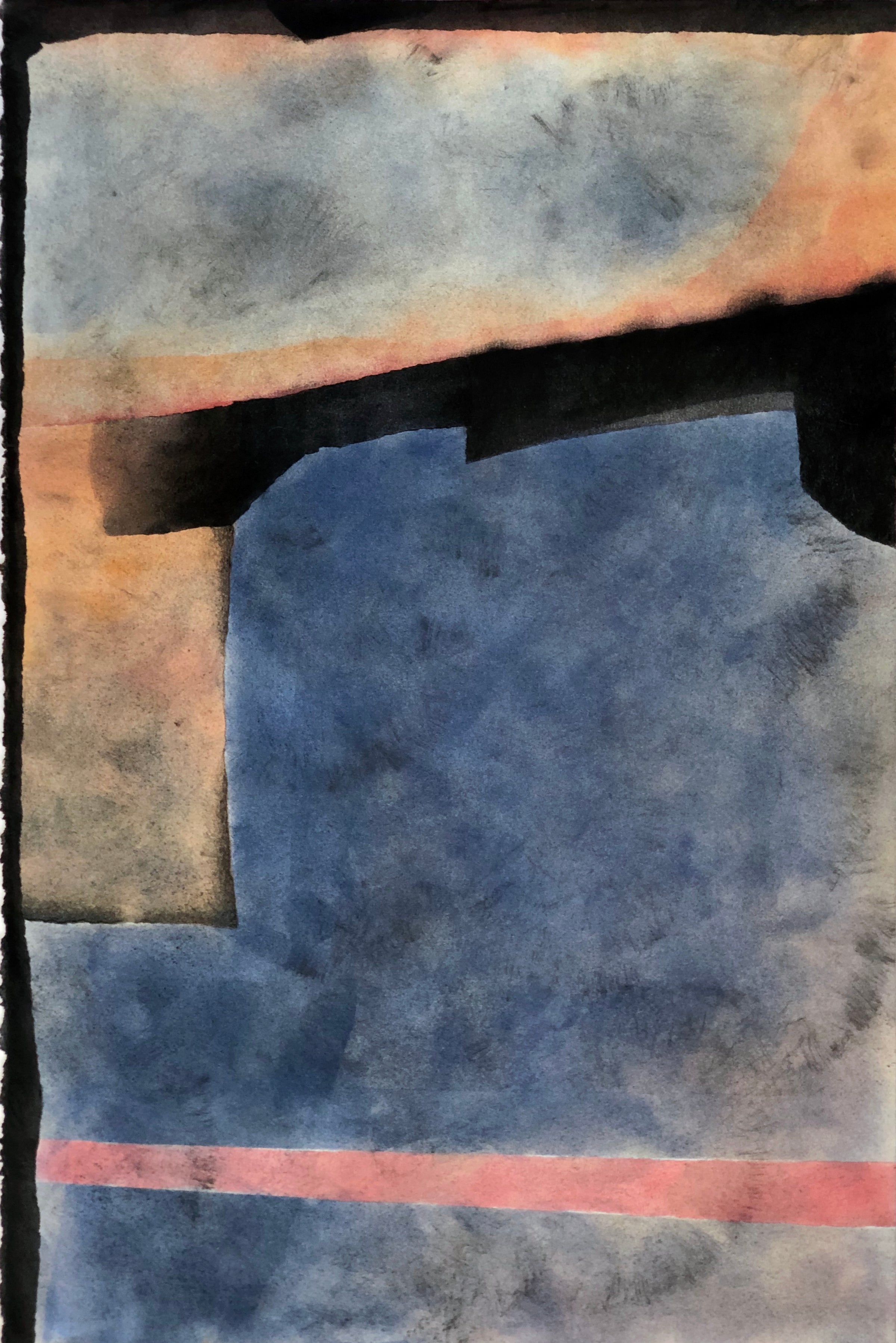
Eric Ketelsen is a Minnesota-based artist whose contemplative abstractions on paper unite experimentation, architectural discipline, and an instinct for quiet beauty. Working with unconventional tools such as fingerprint brushes, makeup sponges, stencils, mesh, and masking tape, he builds layered surfaces that feel both spontaneous and deeply considered. His compositions often reveal beauty in the faded, worn, and imperfect, while maintaining a striking precision of edge, line, tone, and structure that reflects his formal training in architecture.
Born and raised in Clinton, Iowa, along the Mississippi River, Ketelsen developed an early love of art through his mother’s books and his father’s craftsmanship as a master brick mason. After studying liberal arts, spending time in Europe, and earning a degree in architecture from the University of Minnesota, he eventually returned to art with renewed urgency and purpose. Over the past two decades, he has become a respected presence in the Twin Cities art community, exhibiting in galleries, regional art centers, juried shows, and art fairs, with work now held in private collections across Minnesota, Iowa, Illinois, North Carolina, New York, Texas and Canada. For collectors, Ketelsen’s work offers a rare combination of emotional depth, formal sophistication, and intimate scale pieces that reward close looking and continue to unfold over time.

ARTIST STATEMENT
This selection of paintings invites you into a world of subtle radiance and shifting form. While these works on paper possess the fluid, translucent quality of watercolor, they are crafted entirely from fine pastel. The work in this exhibition grows out of an ongoing process of discovery. I often begin with simple materials and unconventional tools—fingerprint brushes, sponges, charcoal, pastel, tape—and allow one gesture to lead to the next. I’m interested in the point where improvisation meets structure, where an image can feel atmospheric and intuitive while still carrying an underlying sense of order. That balance comes, in part, from my background in architecture, where attention to form, edge, rhythm, and composition remains central to how I see and make. These works are not about depicting a specific place or object so much as creating a space for reflection and sustained looking. I’m drawn to surfaces that suggest time, memory, erosion, and repair—to a kind of beauty that feels discovered rather than declared. The pieces in this exhibition are modest in scale but layered in experience; they ask the viewer to come closer, slow down, and notice subtle shifts of tone, texture, and color. I hope they offer collectors something lasting: work that is visually distinctive, emotionally resonant, and quietly transformative in the spaces where it lives.
Little About Eric
What’s something people don’t know about you, or would be surprised to learn about you?
Funny as it sounds, some of my best ideas come to me in the bath. There’s something about the quiet and the warm water that helps me relax and really think about the day’s work. Before long, new connections and ideas start showing up.
What song/album/artist is currently on repeat in your studio?
In the studio, I’ve been listening to a lot of free jazz, avant-garde jazz, and free improvisation. I’ve been slowly making my way through Joe McPhee’s catalog, most recently Nation Time and Six Situations. A little closer to home, I also play Nathan Hanson’s album We Sick with Davu Seru and deVon Russell quite a bit. It’s a little more melodic and atmospheric, and it really fits the mood when I’m working. Nathan actually lives in my neighborhood and started giving front-yard concerts during COVID, which made me appreciate his music even more.
When is your favorite time to create?
I don’t really have one favorite time to create so much as favorite times for different parts of the process. Early mornings are for reading on the porch—artist biographies, art history, criticism, and essays. The best moment to make work is when something I’ve read sparks that strong urge to head into the studio and make something new. I really live for that feeling.
What is your guilty pleasure tv show or movie?
It’s not really a guilty pleasure so much as a standing family tradition. Every Sunday, we watch CBS Sunday Morning, and we especially enjoy the arts segments.
What is an unusual skill you have outside of art?
I’m not sure it qualifies as a skill exactly, but I’ve spent years collecting books on art and art history. I love hunting them down, living with them, and returning to them over time. In a way, building that library has become its own kind of practice.
If you weren’t an artist, what would you love to be doing?
If I weren’t making art, I could easily see myself as an art historian, or maybe someone leading tours centered on art and architecture. I’ve always loved looking closely, learning the stories behind things, and sharing that sense of discovery with other people.
What’s your biggest artistic obsession right now?
Right now, I’m especially drawn to the Bay Area Figurative artists—David Park, Paul Wonner, Elmer Bischoff, Joan Brown—and sculptor Manuel Neri. I keep coming back to the moody light, the sense of space, and the really beautiful, luminous color in their work.
What’s the most unexpected thing you’ve used in an artwork?
It may not seem unusual if you know my work, but I often use fingerprint brushes to apply powdered charcoal. They’re the kind of brushes you might picture in a crime show, or sometimes the soft feathered ones used for dusting. I love them because they create these moody, atmospheric textures that would be hard to get any other way.
What was your first creative memory, or a specific artistic moment that made you realize,“I really want to do this?”
As a kid, I loved to draw. Coloring books, not so much—but drawing and watercolor painting were a big part of my early life. Then, for reasons I can’t entirely explain, that part of me went quiet for a while. Later in life, when my dad was terminally ill, the need to draw and paint came back with real urgency. That was the moment I knew I had to make art.
Where were you born and where did you grow up?
I was born and raised in Clinton, Iowa, right on the Mississippi River. It’s a small town, but I was lucky to be close enough to places like the Chicago Art Institute, the Figge Art Musuem in Davenport, Grant Wood country, and the art colony in Mineral Point, Wisconsin. Those trips gave me an early sense that art could be part of a larger world.
Who are your artistic influences or mentors?
My earliest influence was probably my mother’s bookshelf. She was an artist, and I spent a lot of time flipping through her art books from the 1950s and ’60s. The one that stayed with me most was Bridgman’s Constructive Anatomy. Even though my work is abstract now, I still go back to it for inspiration.
If your art had a personality, how would you describe it?
If my art had a personality and took the Myers-Briggs, I think it would be an INFP sensitive, creative, idealistic, perceptive, caring, and loyal. It would be drawn to harmony and growth, dreams and possibilities.
How would you describe your style to someone unfamiliar with your work?
I make brightly colored pastel abstractions on paper, often using unusual tools like fingerprint brushes and makeup sponges. The work is usually modest in scale and quiet at first glance, but I hope it rewards close looking. I’m interested in a kind of beauty that lives in the faded, worn, and imperfect, balanced with a sense of care and precision.
What color do you use most, and why?
Black—especially charcoal black—shows up in almost every painting I make. For a long time, I worked only in black and white, using charcoal or ink on paper. A lot of that came from my love of drawing, but also from wanting to better understand value, tone, and composition. Even now, when I’m working in color, black still helps anchor the piece.
Eric's Art
-
 Tranquility and Turmoil, IVendor:Tranquility and Turmoil, IEric Ketelsen
- Regular price
-
$1,380.00 - Regular price
-
- Sale price
-
$1,380.00
Quick view


